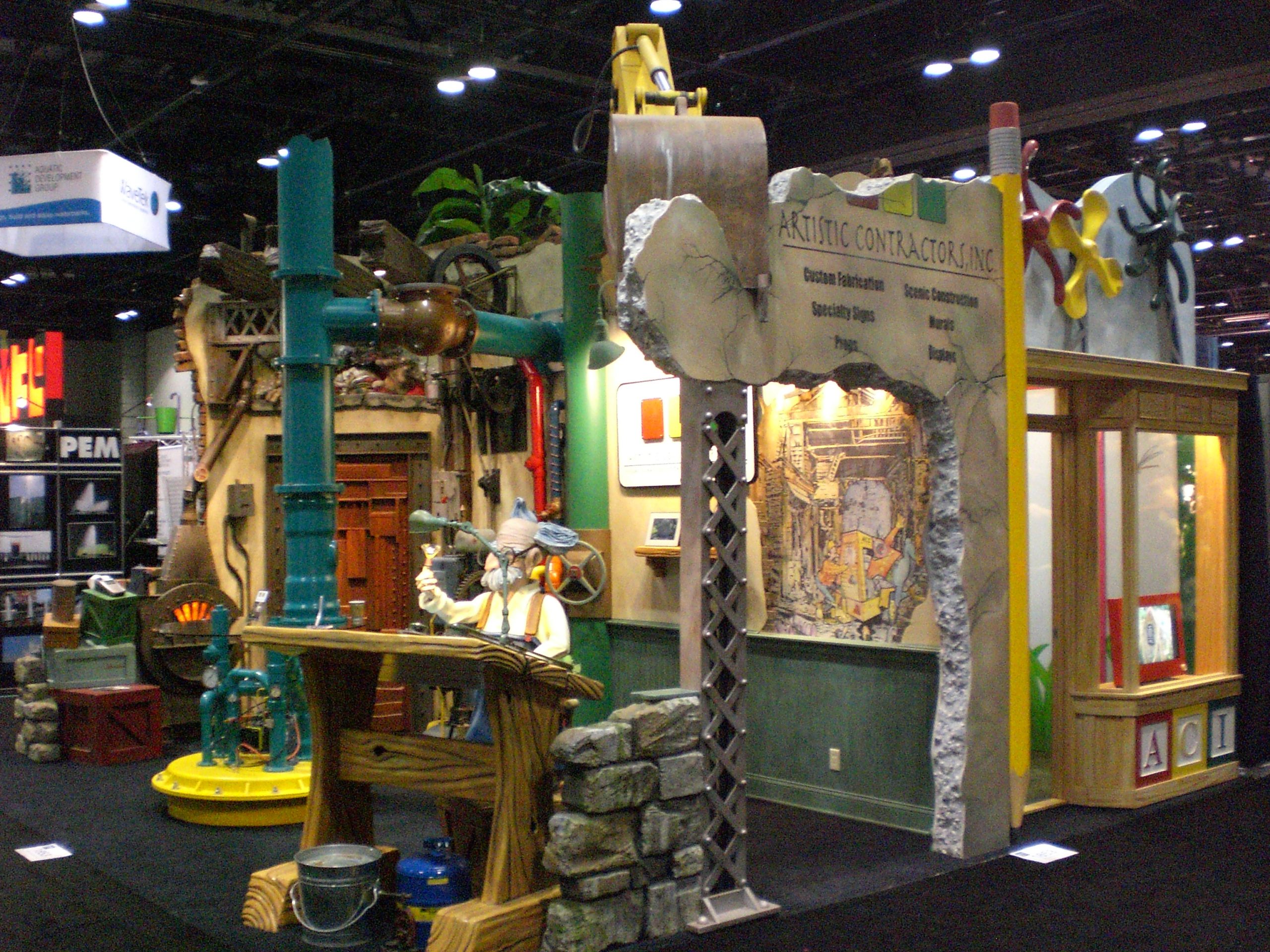

The Trade Show Advantage: How Custom Fabricated Exhibits Outperform Rented Booths
Walk any major trade show floor and you will notice something within the first ten minutes. There are booths you walk past and booths you walk into. The ones you walk into are not always the biggest. They are not always the brightest or the loudest. But they have something the others do not: a physical presence that reads as deliberate, confident, and built specifically for this moment. You stop because the environment itself invites you to stop.
That quality does not happen by accident, and it does not come from a rental catalog.
Trade shows represent a genuinely unique marketing opportunity. According to data from the Center for Exhibition Industry Research (CEIR), approximately 81 percent of trade show attendees carry buying authority, and roughly 67 percent represent entirely new prospects that companies have not reached through any other channel. That is a room full of decision-makers who are actively in discovery mode, walking a floor specifically to evaluate vendors, compare solutions, and make purchasing decisions. The only question is whether your exhibit environment earns their attention or loses it to the booth next door.
This article examines what separates custom fabricated exhibits from rental and modular options, how the economics of custom work across a multi-show program, and how Artistic Contractors approaches the design and build of trade show environments as branded experiential spaces rather than simple display structures.
What a Rental Booth Actually Costs You
The appeal of a rental exhibit is straightforward. Lower upfront cost, no storage requirement, faster deployment. For a company attending a single show with no defined long-term event strategy, a rental may be the appropriate choice.
For companies with an active multi-show program, however, the economics shift significantly. The initial savings of a rental are real. The cumulative cost of renting the same space repeatedly is not difficult to calculate, and it is rarely as favorable as it first appears. Rental cost is paid in full at every show. The structure is never owned. The asset is never built. And critically, the visual result reflects the nature of the structure itself: a rental exhibit looks like a rental exhibit, because the bones beneath the graphics are generic by definition.
Beyond the cost comparison, there is a performance gap that is harder to quantify but consistently reported by exhibitors who have made the transition from rental to custom. A custom-built exhibit can be engineered from the ground up to support the specific way your sales team operates, the specific products or demonstrations you need to present, and the specific impression you need to create at the precise moment a buyer walks past your space. A rental structure cannot do any of those things, because it was not built for you.
CEIR data reinforces the stakes: pre-show marketing generates 46 percent more booth visits than relying on walk-up floor traffic alone, but even the best pre-show marketing sends prospects to your exhibit. What happens at the exhibit itself determines whether a high-intent visitor becomes a qualified lead or continues down the aisle.
The Brand Credibility Problem
Trade show floors are competitive environments. Every exhibitor in your category is present, visible, and spending money to be taken seriously. In that context, the physical quality of your exhibit is a direct signal about the quality of your company, your products, and your commitment to the relationship you are inviting prospects into.
This is not a superficial concern. Buyers attending major industry shows are often making vendor decisions that will affect their businesses for years. They are evaluating trust, capability, and staying power alongside product specification. A generic rental structure communicates, implicitly but unmistakably, that the exhibiting company is either not fully committed to the show or not willing to invest in the relationship at the environmental level. A custom-fabricated exhibit communicates the opposite, without a word being spoken.
The design principles that govern high-performing retail and experiential environments apply directly to trade show exhibits. People make rapid, largely unconscious judgments about environments within seconds of entering them. The proportions of the space, the quality of surfaces and finishes, the coherence of visual elements, and the apparent care with which the environment was assembled all register before a sales conversation has even begun.
Artistic Contractors build trade show exhibits, the design process begins with exactly these questions. What does the buyer see from thirty feet away? What draws them closer? What does the space feel like when they step inside? What materials and finishes communicate the brand’s values without requiring explanation? These are design problems before they are fabrication problems, and resolving them at the design stage is what allows the fabricated result to perform on the floor.
There is a related concept worth naming directly: competitive context. A trade show floor is not an isolated environment. It is a comparative one. Every buyer who visits your exhibit has already walked past your competitors, and will walk past more of them afterward. The quality gap between a custom-fabricated exhibit and a generic rental structure is not just visible in absolute terms. It is amplified by proximity to competitors who have made a different investment. Companies that have made the transition to custom fabrication consistently report that the competitive contrast on the floor is one of the first things their sales teams notice. The conversations that start at a well-designed custom exhibit are different in character from the conversations that start at a rental booth, because the environment itself sets a different expectation before the first word is spoken.
What Custom Fabrication Actually Enables
The advantages of custom trade show exhibit fabrication are not abstract. They translate into specific capabilities that rental and modular structures cannot match.
Purpose-built demonstration environments. If your product requires a live demonstration, your exhibit needs to be engineered around that demonstration. The layout, power routing, surface heights, lighting positions, and traffic flow all need to support what your team actually does during a show. A custom-built exhibit can incorporate dedicated demo stations, integrated technology infrastructure, custom millwork sized precisely for your equipment, and sight lines that direct visitor attention to the demonstration in progress. A rental structure cannot be configured to do this at a professional level because it was not built with your product in mind.
Reusable structural investment. A well-designed custom exhibit is built to last across multiple shows and multiple years. The structural investment is made once. Graphics, messaging, and product-specific elements can be updated at a fraction of the cost of building new. Over a three-year program, the per-show cost of a custom exhibit frequently drops below the per-show cost of a rental, while delivering a substantially higher quality result at every appearance.
Brand-specific geometry and materials. Rental structures come in standard configurations. Custom fabrication allows any geometry, any material, any surface finish. This means your exhibit can carry the same material language as your retail environments, your packaging, or your product design. It can use the same color palette your brand standards specify at the precise values those standards require. It can incorporate architectural details, dimensional signage, and integrated lighting in configurations that no modular system can produce.
Built-in storage and operational infrastructure. Custom exhibits can be designed from the beginning with storage built into the structure. Literature, samples, equipment cases, personal items, and collateral can all have dedicated, concealed space within the exhibit footprint. This keeps the show floor environment clean and professional rather than visually cluttered with the operational realities of a working booth.
The Fabrication Process: From Concept to Show Floor
At Artistic Contractors, our trade show exhibit work follows the same disciplined process we apply to themed environments, stage sets, and immersive attractions. The build quality and the design rigor are the same regardless of project scale.
The process begins with a detailed brief. Before any design is undertaken, we need to understand the show environment (ceiling heights, neighboring exhibits, traffic flow patterns specific to the venue), the brand standards and visual identity that govern all graphic and material decisions, the specific demonstrations or presentations the sales team will conduct, the number of staff working the exhibit simultaneously, and the long-term event calendar so that the structural design can accommodate future shows efficiently.
From the brief, we develop scaled plans and elevations that establish the spatial organization of the exhibit. These drawings are reviewed with the client to confirm that the layout supports the intended sales process before any three-dimensional work begins. Iterations at the drawing stage cost almost nothing. Iterations during fabrication are expensive.
Fabrication draws on the full range of Artistic Contractors’ capabilities: custom millwork and cabinetry for counters, display surfaces, and storage; CNC routing for dimensional signage and precision-cut graphic surfaces; metalwork for structural elements, hardware, and decorative details; specialty finishes including faux textures, scenic painting, and custom color matching; and custom sculpted props and branded environmental elements for exhibits that require a signature three-dimensional presence.
Every component is designed with installation efficiency in mind. Trade show installation windows are often measured in hours, not days. An exhibit that cannot be assembled quickly and correctly by a small crew is a liability on the show floor. Our fabrication process accounts for this by engineering connections, panel systems, and assembly sequences that allow a professional installation team to work efficiently under show conditions.
Lighting as a Design Element
Lighting deserves specific attention in the context of trade show exhibits, because it is one of the most consistently under utilized element in exhibitor budgets and one of the highest-performing investments available.
The Illuminating Engineering Society’s guidelines on commercial lighting distinguish clearly between ambient illumination and accent or display lighting. In a trade show hall, ambient illumination is provided by the venue and is typically flat, diffuse, and identical across every square foot of floor space. Every exhibitor starts with the same baseline lighting condition.
An exhibit that adds its own lighting infrastructure immediately differentiates itself. Warm accent lighting directed at product displays creates visual depth and draws the eye to exactly where the exhibit wants attention. Up lighting on architectural elements creates a sense of scale and presence that flat ambient light cannot produce. Backlit graphics read at a distance in a way that front-lit graphics do not. Colored lighting used deliberately within a branded exhibit can reinforce color associations and create an environment that feels genuinely different from the surrounding floor.
In custom-fabricated exhibits, lighting is designed into the structure from the beginning. Power routing, fixture mounting positions, and dimmer infrastructure are all built in rather than added as afterthoughts. The result is an exhibit where lighting is a design element rather than a logistical problem.
Planning Your Custom Exhibit Program
The practical considerations for a custom trade show exhibit program begin well before the first show. Lead times for custom fabrication typically run four to six months for a complete exhibit build, depending on complexity. Starting the design process at the same time as show space is reserved gives the design and fabrication team sufficient time to do the work correctly without compression.
Budget planning for a custom exhibit program should account for the full lifecycle of the asset, not only the initial fabrication cost. Storage between shows, transportation and freight, show services (electrical, drayage, rigging), installation and dismantling labor, and periodic graphic updates are all recurring costs that need to be understood from the beginning. A well-designed exhibit minimizes these ongoing costs through efficient shipping configurations, durable materials that resist handling damage, and modular graphic systems that allow messaging updates without structural changes.
For companies attending their first major show with a custom exhibit, we recommend building with the second and third show in mind. The structural investment is made at the first show. The return on that investment accumulates across the entire useful life of the exhibit. Designing for reuse and adaptability from the start is what allows the economics of custom fabrication to deliver their full advantage.
One practical consideration that is often overlooked in the planning phase is the relationship between exhibit footprint and booth configuration. Trade show floor plans vary. A 20×20 island configuration at one show may be a 10×20 inline configuration at another. A well-designed custom exhibit anticipates this variability. Structural elements can be designed to reconfigure between footprints without requiring new fabrication, allowing the same asset to work across different show contexts. This requires deliberate design thinking at the outset, but it is entirely achievable and it significantly extends the practical life and cost efficiency of the exhibit investment.
Staffing the exhibit is another variable that custom design can address directly. The layout of the exhibit determines how many staff members can work simultaneously, where they are positioned relative to incoming traffic, how product demonstrations are staged, and whether the environment creates natural conversation zones or simply an open floor with nowhere to focus. These are spatial design decisions with direct consequences for sales performance, and they are decisions that can only be made correctly when the exhibit is being designed specifically for your team and your sales process.
When a Custom Exhibit Changes the Conversation
The measurable outcomes of a well-designed custom exhibit are documented consistently across the trade show industry. CEIR research shows that exhibitors who invest in quality booth environments and align them with a pre-show outreach strategy generate meaningfully more qualified booth visits than those who rely on walk-up floor traffic alone. The exhibit is not the only variable, but it is the one that determines what happens after a prospect has been drawn in. Qualified lead volume, meeting requests, and post-show follow-up rates all correlate with exhibit quality and the quality of the visitor experience the exhibit creates. The physical environment of the booth shapes the quality of every conversation that happens inside it.
More fundamentally, a custom trade show exhibit is a statement about how seriously a company takes its presence in a market. It communicates investment, permanence, and attention to detail in a setting where every competitor is making the same calculation. For brands with genuine ambitions in their category, the exhibit is not simply a place to stand. It is the most concentrated, highest-intent brand experience their prospects will ever have.
Artistic Contractors brings to trade show exhibit work the same capabilities and the same design discipline we apply to world-class themed immersive environments for major theme parks, resorts, and entertainment venues globally. The scale is different. The principles are identical: design the environment for the specific experience you want your audience to have, then fabricate it at the quality level that experience demands.
If your current exhibit is working against you, or if your event program has outgrown what a rental structure can deliver, we would welcome the conversation.
Artistic Contractors Inc. is a world-class themed environments and custom fabrication company headquartered in Atlantic Beach, Florida. We design and build custom trade show exhibits, immersive brand environments, themed attractions, and sculptural installations for clients across North America, the Caribbean, and internationally. Contact us at (904) 853-6853 or visit artisticcontractors.com to discuss your next project.